Buying Acreage in Douglas County Oregon: What to Review
June 4, 2026
June 4, 2026
Thinking about buying acreage in Douglas County? The views, privacy, and extra space can be a great fit for your lifestyle, but rural property comes with questions that do not always show up in a typical home purchase. Before you commit, you need to know what the land allows, how water and wastewater are handled, and whether access and future improvements will work the way you expect. This guide walks you through the biggest checkpoints so you can move forward with more clarity and fewer surprises. Let’s dive in.
When you buy acreage, you are not just buying a home. You are also buying a set of land-use rules, utility realities, and property constraints that can affect how you live on the property later.
In Douglas County, those details matter early. The county’s Land Use and Development Ordinance, or LUDO, separates parcels into different zoning categories, including resource zones and rural residential zones, and those categories can shape everything from building plans to outbuilding options.
One of the first questions to ask is simple: What is this parcel zoned for today, and what does that allow later? That answer can affect whether you can build, expand, divide land, or add structures in the future.
Douglas County’s zoning list includes resource zones such as Timberland Resource, Exclusive Farm Use, Farm Forest, and Agriculture and Woodlot, along with rural residential zones like 5R, RR, and 1R. A property may look like it has room for your plans, but the zoning may set limits on what is actually allowed.
If you are hoping to build a home, add an ADU, divide the parcel, or make major improvements, Douglas County says the planning process should be identified first. In many cases, planning approval comes before building permits or onsite septic permits, and some projects require a pre-application conference and formal land use review.
Resource-zoned land and rural residential land are not treated the same way. That is important if you are shopping for space for a shop, barn, horse setup, or long-term expansion.
A parcel in a rural residential zone may support one set of uses and size limits, while a parcel in a farm or forest-related zone may follow a different path altogether. The safest move is to confirm the exact zone and ask how your intended use fits within current county rules.
Some acreage in Douglas County may be in farm use special assessment or forest special assessment. These programs can reduce assessed value, which may affect the property tax picture.
That benefit can come with strings attached. Douglas County notes that if the property later disqualifies from the program, it may trigger a Potential Additional Tax, so you will want to understand that status before closing.
If your plans include changing how the land is used, this becomes especially important. A lower tax bill today does not always mean the same tax treatment will continue after your purchase.
On many Douglas County acreage properties, water comes from a private well. That means the well is not something to glance at during a showing and forget about until after closing.
In Oregon, private wells are the property owner’s responsibility and are not maintained or regulated by the state or county government. Oregon health and environmental agencies recommend testing private well water every one to two years, even though testing is legally required at transfer only in certain situations.
If a property transfer involves a domestic well, Oregon law requires the seller to test for arsenic, nitrate, and total coliform bacteria. The seller must also share the results and the Real Estate Transaction form with the buyer and the Oregon Health Authority within 90 days of receiving the results.
There are exceptions. Spring wells, irrigation-only wells, and wells on undeveloped land are exempt from that testing rule.
Oregon also requires a well ID label to be attached within 30 days after a property transfer if the well does not already have one. That makes well documentation part of your closing checklist, not just a side note during inspections.
For buyers, the practical takeaway is clear: ask for test results, confirm the well type, and make sure the well records and identification details are in order before you remove contingencies.
For undeveloped acreage and many rural homes, septic is one of the biggest make-or-break issues. Even if a property already has a system, you still need to know whether it supports your plans.
Oregon DEQ recommends that buyers of undeveloped land ask for a site evaluation report. For developed properties with an existing septic system, DEQ recommends having the system inspected by a qualified professional before purchase.
Changes to a property can affect septic viability. DEQ notes that well construction, fill, driveways, and other site changes may alter septic suitability or interfere with an approved location.
That matters if you want to add a shop, move a driveway, or change the homesite layout. A parcel may have enough acreage on paper, but the usable area for septic and development may be more limited than expected.
Douglas County’s On-Site Wastewater program keeps historic septic records and offers record-request options. Those records can help you verify permits, system size, and prior issues before you commit.
This is one of the easiest places to avoid surprises. If the septic history is unclear, it is worth slowing down and getting answers.
Acreage buyers often focus on the house, the views, and the land itself. But access can affect daily convenience, financing, emergency response, and resale value.
Douglas County regulates access to county roads through its Public Works Department and access permit process. Access grants are issued only to owners or lessees of property that abut a county road, and decisions depend on road classification and safety.
If the property is served by a private road or easement, verify who maintains it and how costs are shared. In land division settings, Douglas County’s code contemplates private-road maintenance agreements, covenants, pro rata maintenance costs, and nonexclusive access easements.
That means you should confirm more than just whether a road exists. You also want to know whether the recorded documents match the way the road is being used today.
If you plan to improve a driveway, culvert, or do other work in county right-of-way, Douglas County requires a right-of-way activity permit. The county also notes that driveway approaches must be built so they do not interfere with maintenance operations and must accommodate emergency vehicle access and applicable fire-protection requirements.
The county also states that it assumes no liability for damage to a road or driveway approach caused by roadway maintenance or improvements. So if access is a big part of your purchase decision, it is smart to understand both the current setup and what future work may require.
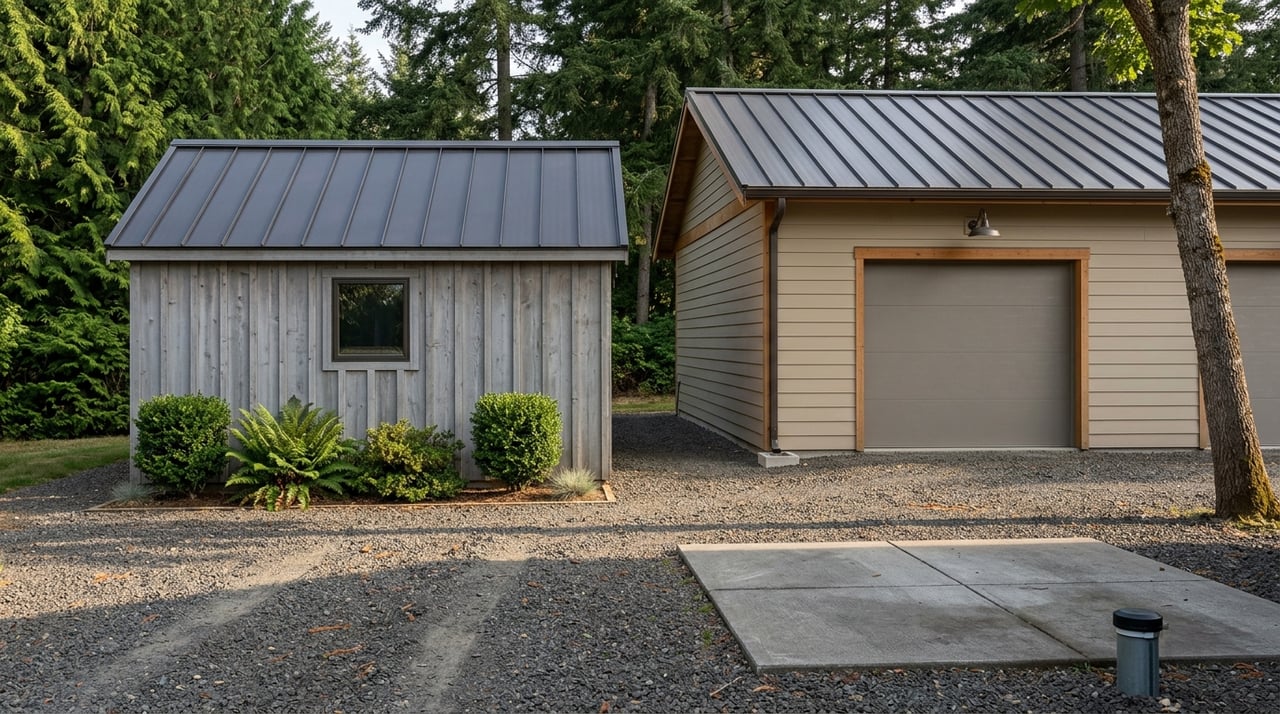
Acreage buyers often imagine future improvements right away. Maybe you want a barn, a large shop, a greenhouse, or an animal shelter. Those ideas may be possible, but the answer depends on zoning, building size limits, permits, and in some cases septic capacity.
Douglas County generally requires construction permits before building, with limited exemptions. The county does exempt some small accessory structures, including certain non-habitable detached structures up to 200 square feet and rigid framed fabric-covered accessory structures up to 500 square feet when specified conditions are met.
In the 5R zone, accessory buildings such as garages, storerooms, woodsheds, hobby shops, greenhouses, and animal shelters are allowed if they do not exceed 2,000 square feet. In that same zone, additional dwellings require five acres per dwelling plus sanitation approval.
In the RR zone, accessory buildings tied to a single-family dwelling that exceed 2,000 square feet may still be allowed if the proposal meets county standards. In the 1R zone, accessory buildings are limited to 1,500 square feet.
For some farm and forest parcels, Douglas County’s Agricultural Building Agreement states that agricultural buildings customarily provided with farm or forest use may be exempt from the state structural specialty code. That can include certain equine facilities and dog training facilities.
Even so, mechanical, plumbing, and electrical permits may still be required. The agreement also states that agricultural buildings on TR, FF, or AW land may not be converted to another use, so it is important to confirm not only whether a structure is allowed, but also how it can be used after it is built.
Before you move forward on acreage in Douglas County, make sure you have answers to the basics.
Acreage can be a great fit if you want more privacy, room to spread out, or space for hobbies and equipment. But the best rural purchases usually come from careful questions up front, not assumptions made after closing.
In Douglas County, the safest approach is to verify zoning first, then confirm water, wastewater, access, and outbuilding potential before waiving contingencies. That extra diligence can help you avoid buying a property that looks perfect on the surface but does not support the way you want to use it.
If you are comparing acreage, horse property, or rural homes around Roseburg and across Douglas County, having steady guidance can make the process feel much more manageable. When you want a local team that will help you slow down, ask the right questions, and stay on top of the details, reach out to Gina Evenich to schedule a consultation.
From first-time buyers to seasoned investors, we treat every client’s goal as our own. We pride ourselves on strong communication and a detail-oriented approach that protects your interests at every turn. Reach out to us for a supportive, professional real estate experience.